what happens to kids who grow up with parents in an unhappy marriage
I call up him, that fiddling male child with curly pilus. He'd sit quietly in form, piddling with his fingers all the time.
1 day, information technology happened. It started as a minor argument betwixt him and the girl sitting adjacent to him over an eraser, and before we knew it, it escalated speedily.
The male child punched the girl repeatedly until her nose started haemorrhage. He said, "Boys can hitting girls." After that 24-hour interval, I never saw him over again.
Back home, I could hear our moms talking about how the poor kid was from a broken family, and how he had probably picked that notion from his begetter who would beat upwardly his female parent regularly.
I didn't sympathize what that meant then, but now I do.
Being in an abusive relationship is scary.
The person who is supposed to honey you lot the virtually, protect y'all from the globe, and shower you with attention and kindness is the person who is now pain you physically and emotionally.
Information technology's frightening, hurtful, and confusing all at the same fourth dimension. But then, you put up with it because yous keep hoping information technology will modify.
Merely the dynamics alter when at that place are children in the picture.
For someone in an calumniating human relationship, calling it quits and parting ways becomes a dissimilar ball game because of fear almost the touch on it would have on their children.
It'south true that kids from broken families suffer some pain and difficulty dealing with the terminate of their parent's human relationship. This is especially true if the divorce or break-up is acrimonious.
However, growing up with parents who have abusive relationships isn't going to exercise them a world of expert either. In fact, information technology does much worse.
So, here'south the matter.
Children are better off with separated parents than beingness raised in an abusive environs. The impact this kind of an atmosphere has on the minds of children is extreme.
And so, if y'all have children, and you lot live in an abusive human relationship, for heaven's sake, do yourself and your children a favor. Go out of it!
If y'all're staying with your partner for the sake of your children, you need to be aware of how information technology's impacting them.
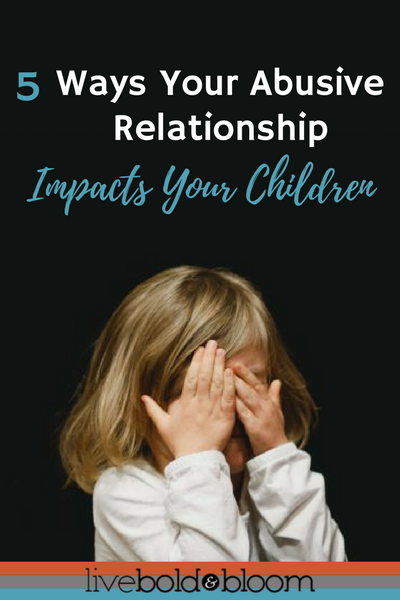
V ways abusive relationships impact your children:
1. Corruption alters your child's perceptions.
First of all, it's important to place whether you are in an abusive relationship.
There are many people who assume that abuse pertains just to physical violence. That'southward not truthful.
Verbal and emotional abuse are as abusive as being physically violent. If your partner swears at you or raises his voice and talks to you in a derogatory fashion, that's abuse too. If he controls, manipulates, and plays mind games with you, that is besides abuse.
When your children see your partner engaging in any form of abusive behavior, they may assume that information technology's a "normal" way to interact in a spousal relationship or love relationship. They may misfile dear with pain, violence, criticism, and command.
They may feel frightened and dislocated, but as long every bit you every bit the adult accept the abuse, your kid assumes it must be acceptable.
These conflicting feelings cause them a keen deal of inner turmoil they don't have the skills or judgment to handle. When a parent is violent or emotionally ambitious, a kid becomes distrustful and can accept difficulty bonding, which tin play out in peer and romantic relationships when they go adults.
If you can't understand why your calumniating partner behaves the way he or she does, and it causes y'all grief, confusion, and pain, imagine how it must impact your child'due south perceptions of a loving, safe home surroundings.
2. Abuse sets a terrible example.
Children learn past observing. Like the niggling boy I mentioned earlier, children imitate their parents.
If they grow up in an abusive household, they might believe that abuse isn't wrong — or at to the lowest degree that it is an option when things don't become your way.
The boy who said, "Boys tin hit girls," was imitating what he had seen at domicile. Imagine if the child grows upwardly with the same mindset and gets into a relationship with a girl. The cycle of abuse would never cease.
Many children growing up in this kind of a relationship accept cues from the abusive parent and behave in the aforementioned way with the other parent or with a sibling. For example, if a child observes his father verbally abusing his mother, he might behave in the same manner.
If the child sees her mother manipulating her male parent in club to get something, the child views manipulation as an acceptable way to get your needs met.
Children have a natural propensity to place with force, so it's non uncommon for a child to ally themselves with the abuser and lose respect for the victim/parent.
Fifty-fifty if yous children don't witness abuse directly, the tension and discomfort created past the dynamic will infect your kids. They will feel insecure and hyper-vigilant, always wondering why things feel so unhappy and strange at domicile.
3. They self-protect with extremes.
Children pick upwards many of their characteristics from their parents.
I've never seen my own father enhance his voice, so when I hear someone yell, I go very scared. For me, fifty-fifty an argument must exist conducted in a quiet voice. Otherwise, I go out the room or get-go crying. That'due south the way I have grown up and what feels safe for me.
Similarly, when a child has an abusive parent, he or she picks up a lot of self-protective habits that can be traced dorsum to the atmosphere in the babyhood habitation.
For a child who has grown up in an abusive abode, chaos becomes a normal part of their lives, only it leaves a deep scar on their personalities. They either abound up to be aggressive, manipulative, and controlling, or they get very timid, insecure people.
Says Steven Stosny, Ph.D., "Witnessing a parent victimized is often more psychologically dissentious to children than injuries from direct child abuse." Just seeing emotional or physical abuse of one parent past another is more emotionally scarring than if the child were striking or punched by a parent.
While children from broken or divorced families do experience some difficulties every bit adults, kids in an abusive household accept much more to contend with emotionally as they grow up.
They tin go extremely doubtful of everybody, making them guarded and defensive, or they trust people too easily and end upwards becoming vulnerable to abuse themselves.
Most parents desire to give their children the best possible home environment. This is ane reason victims of abuse try to pretend that everything is OK when it's clearly non. They desire to protect their kids, but an abusive relationship is non ideal for whatsoever kid no matter how hard you may try to hide it.
Witnessing abuse at home or having to walk on eggshells and so every bit not to upset the calumniating parent will twist their emotional development and sense of self-esteem, leading them to be extremely insecure or overly aggressive.
Read Well-nigh The Signs Of Emotional Abuse
iv. They suffer from mental health problems.
Children abusive, dysfunctional families tin show signs of post-traumatic stress disorder, particularly in the aftermath of a tearing event. Young children may experience bedwetting, nightmares, and other slumber disturbances. They take a much higher risk of anxiety and depression as teens and adults.
Children in abusive families often feel helpless and hopeless, with little control or power to change the situation. They as well feel shame and embarrassment about their situation. These feelings can lead to thoughts of suicide as a mode to escape the fear and hurting.
Considering they come up from a very cluttered and vehement atmosphere, they are an anxious bunch. They often accept panic attacks, and they are worried almost the parent who is beingness abused. They're overtly protective, at times, and information technology's seen that when these children grow up and have a relationship, they might be a tad bit choking, leading to failed, or dissatisfying experiences.
Their mental wellness issues tin can atomic number 82 to problems in school — truancy, low motivation, and poor grades. These schoolhouse issues tin further impact their cocky-esteem.
5. They are starved for attention and amore.
When children grow up in a troubled environment, they fail to get the intendance and nurturing that other children of their historic period receive. One or both of their parents neglect them, leaving the child emotionally starved and feeling unloved.
Their parents are so involved in handling their own crises that they fail to give their children the time, attention, and affection they need. In calumniating households, 1 or both parents might be absent for long periods, depressed, impaired by drugs or alcohol, or simply emotionally unavailable.
Not only does the child lack attention and affection, simply besides he or she may non receive the discipline, training, and guidance necessary to become a fully-functioning, emotionally mature developed.
Defective in love and attention at dwelling, children in abusive relationships might end up hanging with the incorrect crowd to feel valued. They might become sexually active too early or sexually promiscuous.
A child who didn't receive affection and nurturing at habitation might spend the rest of their adult lives trying to win love from others, while never really feeling lovable.
Because the surround they live in is not affectionate, they might also develop into cold people, devoid of empathy and understanding, causing them issues in adult relationships. They might besides abound to hate one of their parents or both of them, thank you to the atmosphere they've been raised in.
If you are in a physically or emotionally calumniating relationship, consider the profound impact your situation is having on your children's lives. As painful as divorce or ending the human relationship may be, you are an developed and have the skills to cope and motility forward. Your children need a responsible adult to stand up upwardly for them and create a safe, secure, loving, and emotionally healthy environment.
Ask yourself these questions:
- Volition this human relationship change for the better?
- Will the abuser in your life change his or her behavior?
- Is your relationship going from bad to worse?
- Are you alright putting your children through this trauma?
- Is your calumniating relationship worth the lasting negative impact it'southward having on your kids?
- Answering these questions will give some direction and aid understand where this is all headed.
For the safety of children and for their emotional development, the solution lies in either putting an finish to the abuse or putting an terminate to the relationship.
Author Bio

Aradhana Pandey writes near parenting, children with special needs, health and lifestyle. She writes to share her knowledge and so that it may assist others. Her posts on these subjects take been published on more than 250+ various sites similar the Huffington Postal service, SheKnows, Mom Junction, and many more.
Source: https://liveboldandbloom.com/01/relationships/abusive-relationship
0 Response to "what happens to kids who grow up with parents in an unhappy marriage"
Post a Comment